Overview
Solution Builder is where LinkedIn's sales teams assemble enterprise deals. Pricing offers could improve almost any deal, but reps had to remember which ones a customer qualified for, what each allowed, and whether applying it would trip an approval or dent their own compensation. Most of that lived in enablement docs and tribal knowledge, so good offers went unused and custom discounts drifted off-platform. Rep Selected Offers (RSO) brings every eligible offer into the quote itself: rules-driven, transparent, and within guardrails.
The problem
Pricing a deal meant leaving the deal. To apply even a single discount, a rep had to figure out what a customer qualified for, track it down outside Solution Builder, then come back and enter it by hand, and wait on approval for anything at all.
"I know what I want to offer this customer. I just can't get the tool to let me do it, so I work around it."
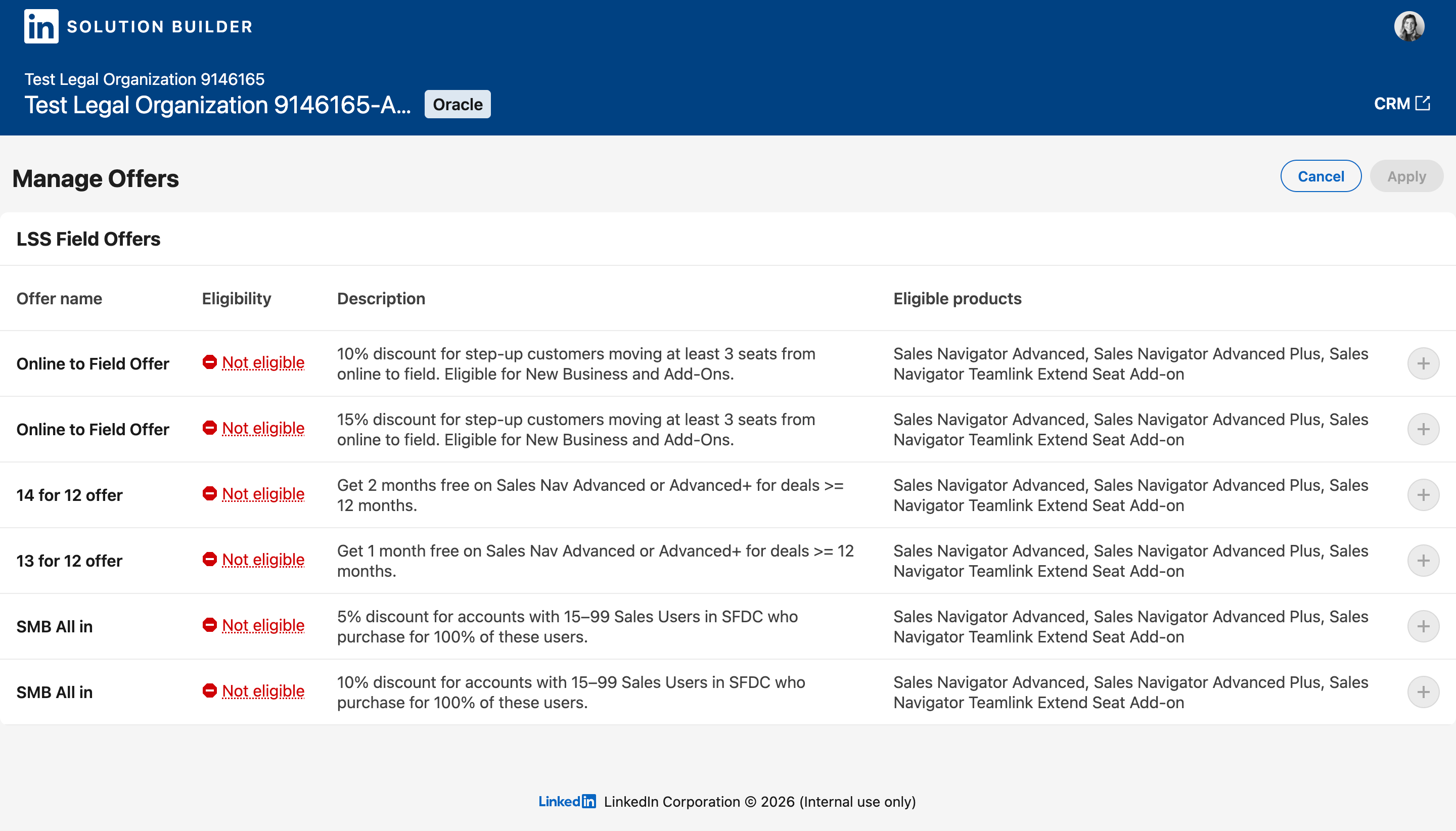
LinkedIn Account Director- Discounts live offline. Eligible discounts and offers sit in spreadsheets and enablement docs, so reps hunt for the right one based on each quote's parameters.
- Applying them is manual. Once a rep finds a discount, they switch into Solution Builder and key it in by hand.
- Everything needs sign-off. With no pre-approved ranges, every discount, even a small, clearly eligible one, waits on approval before the rep can move.
Process
We anchored the work in three questions: What can a rep safely decide on their own? Where must the system step in? And how do we make the right path the fastest path?
Research & framing
We did our own research, mapping how reps actually discover and apply offers today and where memory and policy quietly failed them. That surfaced the real decision points: where governance genuinely mattered, and where it was just friction a rep would route around.
Key decision
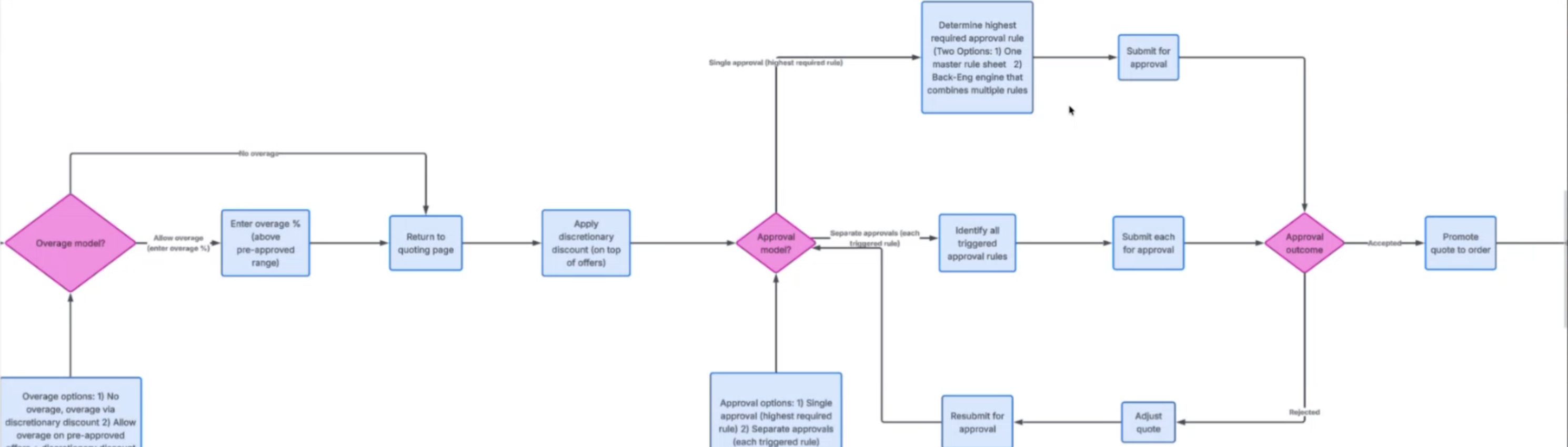
We landed on a guardrailed builder. Reps get real flexibility to shape an offer, but the system surfaces only what a customer qualifies for, holds every choice inside its pre-approved range, and routes anything beyond a rep's authority to the right approver inline, without leaving the flow.
Solution
RSO turns a scattered, memory-driven task into a structured in-quote flow. Three ideas carried the design:
Every eligible offer, in the quote
Instead of relying on memory, reps see exactly what each customer qualifies for at the line level, with the definition and conditions for each, grouped so it never overwhelms.
Pre-approved ranges, enforced live
Reps choose a discount within each offer's pre-approved range, defaulting to a sensible mid-point. The tool holds them inside policy and tracks the running total against the pre-approved ceiling, so a safe deal needs no sign-off.
Approvals and comp impact, made obvious
When a choice does need approval or would affect a rep's multi-year credit, the tool says so up front and routes it inline, instead of surprising them after the quote is built.
Reflection
The hardest part wasn't the interface, it was deciding where to draw the line between rep freedom and system control, and making that line feel helpful rather than restrictive. The win came from designing guardrails that explained themselves, so reps trusted the tool instead of routing around it.