Overview
Sales Navigator is where LinkedIn's own sellers prospect. But to prioritize leads, reps had to toggle between Sales Navigator and a number of LinkedIn internal tools, such as Merlin's Prospect Finder, stitching signals together by hand, deal after deal. We brought LinkedIn's first-party data directly into Sales Navigator's Lead Search as native filters, letting reps prospect from one platform. It shipped to LinkedIn's internal sales teams as the first pillar of the company's "Customer Zero" Sales Navigator vision.
This was also my first time owning the product, not just the design. At LinkedIn we call that a full-stack builder: one person steering the strategy, the spec, and the design end to end.
The problem
Prospecting is mission-critical: SD reps spend ~60% of their time on it. But the internal workflow was fragmented: the first-party signals reps relied on to prioritize leads lived in other internal systems, not Sales Navigator, so reps constantly switched tools and stitched the picture together by hand.
"By the time I've jumped between Merlin, Sales Nav, and the CRM to figure out who's worth contacting, half my prospecting time is gone."
LinkedIn Account Executive- A productivity tax: tool-switching cost reps 4 to 8 hours per week, roughly $3.6M a year in lost productivity.
- The signals lived elsewhere: 55% of Merlin searches relied on just four data signals that Sales Navigator didn't have.
- An adoption gap: some sales teams sat at just 44% weekly active use vs. 75% for others, despite 99%+ license activation.
Process
The tempting move was to rebuild all of Merlin's filters inside Sales Navigator. We framed the work differently: find the few signals that actually drive prospecting, and bring those in first.
Research & framing
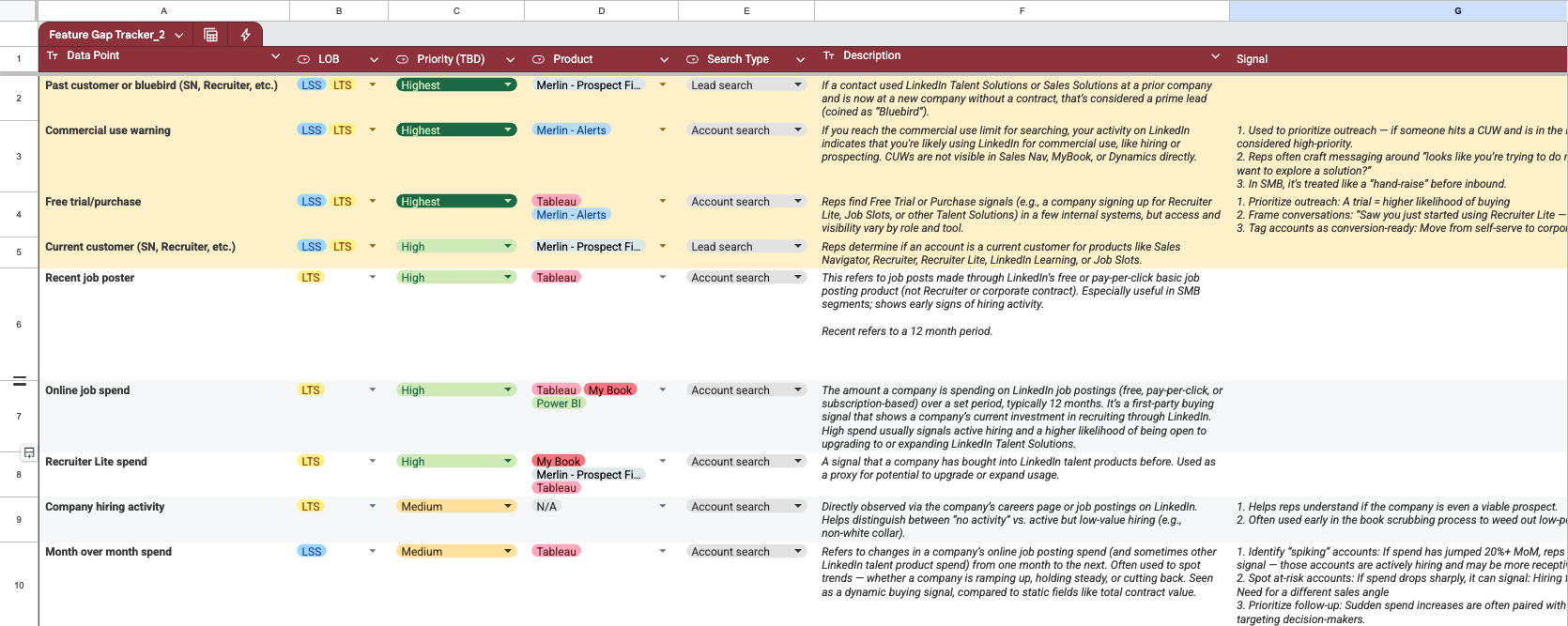
Partnering with PM and data science, we dug into Merlin's Prospect Finder usage data to turn an anecdotal question, "which signals matter?", into a quantified one. The data was decisive: a small handful of signals accounted for the majority of real prospecting searches.
Guiding principles
A few principles shaped how we approached it:
- Quantify before you build. We let Merlin's usage data, not opinion, decide which signals were worth bringing over.
- Extend the workflow, don't add to it. The signals had to live inside Sales Navigator's existing Lead Search, so reps gained capability without learning a new tool.
- Treat trust as a feature. A filter only helps if reps believe its results, so data accuracy and governance got as much attention as the interface.
Key decision
We shipped the highest-value P0 signals as native filters: active & previous subscriptions, recent job posters, and company page admins, and invested just as heavily in making that data accurate and properly governed. The rest of Merlin's signals were phased deliberately rather than ported wholesale.
Solution
The result brought LinkedIn's first-party data into the prospecting flow as native search filters. Three ideas carried the work:
The right signals, not all of them
Rather than port every internal signal, we used usage data to find the handful that drove most prospecting, and brought those in first.
First-party filters, native in Lead Search
Active & previous subscriptions, recent job posters, and company page admins, right where reps already search, with no tool-switching.
Data reps can trust
Surfacing the signals was only half the job. They had to be right. We worked diligently with engineering on data accuracy and with legal on governance, so every internal user gets the insight and trusts it's correct.
Impact
Shipped to 100% of internal sales teams (Feb 2026). Eight weeks after launch:
Reflection
Two things really stuck with me. The first was the value of restraint. It would have been easy to recreate all of Merlin inside Sales Navigator, but the data was clear that only a handful of signals carried most of the value, so we shipped those first and proved them out on our own teams as "Customer Zero." The second was that trust is everything. None of it would have mattered if reps didn't believe the data, and earning that belief meant working closely with engineering to get the numbers right and with legal to clear the governance hurdles.
On a personal note, stepping into the product role for the first time stretched me in the best way. Owning the strategy and the spec, not just the design, made me a sharper partner to engineering and a more decisive designer. It's the kind of end-to-end ownership I want more of.